A small business owner was setting up a website to sell handmade candles online. The domain name they wanted was already taken with the usual ending, so they bought the same name with a different, cheaper extension instead.
They built a lovely website and started sharing the link with customers.
A few weeks later, a customer messaged saying, "I tried opening your website, but my email provider is warning me it might not be safe. Is this really your site?"
The owner was confused. Their website had no virus, no hacking, nothing wrong with it. So why was it being treated with suspicion?
The answer had nothing to do with their content — and everything to do with the last part of their domain name.
Let's understand what it really means.
What Is TLD Reputation?
Every website address ends with something like ".com", ".org", ".shop", or ".xyz". This ending is called a TLD, short for Top-Level Domain.
Not all TLDs are treated equally by the internet. Some domain endings have earned a good name over the years because they're mostly used by genuine businesses. Others have become popular among spammers and scammers simply because they're cheap or easy to get in bulk, without much verification.
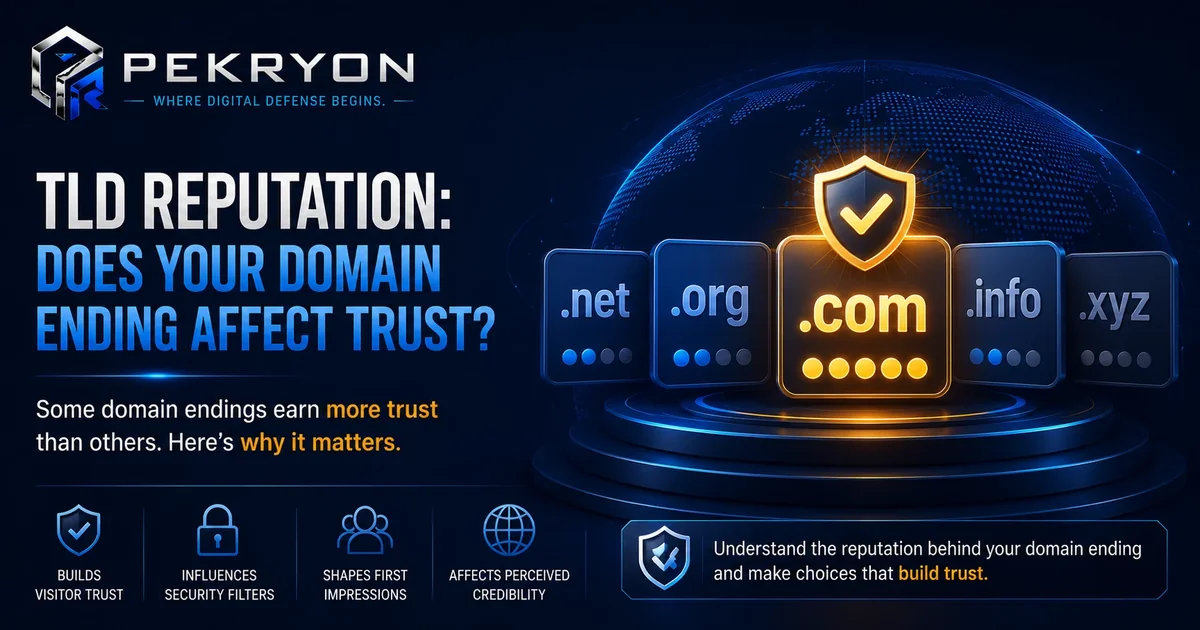
TLD reputation is a trust score given to a domain ending, based on how it has generally been used across the internet. It's a bit like how a neighbourhood can build a reputation over time — one area becomes known as safe and welcoming, while another becomes known for frequent trouble, even though individual houses in both areas could be perfectly fine.
Your website's TLD actively shapes how browsers, email providers, and even careful customers judge your website before they've read a single word on it.
Not All TLDs Work the Same Way
Before going further, it helps to know that TLDs fall into a few different groups, and mixing them up is where most confusion happens.
- Restricted TLDs — endings like .gov (government) and .edu (educational institutions) cannot simply be bought by anyone. The organisation has to prove who they are before they're even allowed to register. This upfront verification is why people instinctively trust these endings — the trust comes from the gatekeeping, not just general reputation.
- Long-established open TLDs — endings like .com, .org, and .net, along with most country-specific extensions, can be bought by anyone, but they've been around for decades and are used by a huge number of legitimate businesses. Their strong reputation comes from a long, mostly clean track record.
- Newer or low-cost open TLDs — extensions that are cheap or easy to register in bulk can attract more spam and scam activity simply because there's less friction to misuse them. This doesn't mean every website using them is untrustworthy — it just means the extension, as a group, gets treated with more caution by default.
So when people say "some domain endings are riskier," they mean this last group — not restricted ones like .gov, which work on an entirely different, verified system.
It's also worth knowing that choosing a domain ending that matches your industry (like one aimed at online shops) helps mainly with branding and clarity, not reputation. It makes your website easier to understand at a glance, but it doesn't automatically raise or lower how much email providers and security tools trust it. Reputation is earned from real-world behaviour across the entire TLD over time, not from how well it matches your business type.
Why Should You Care About This?
- Email delivery — emails from certain domain endings are more likely to be marked as spam by default, simply because that ending has a history of spam abuse.
- Browser warnings — some browsers and security tools treat websites with lower-reputation TLDs more cautiously, sometimes showing extra warnings.
- Customer trust — many everyday internet users have learned to instinctively trust familiar extensions more than unfamiliar ones, even if they can't explain why.
- SEO impact — while the TLD itself isn't the biggest ranking factor, a domain with a poor reputation history can indirectly affect how search engines and security tools view your site.
None of this means your business is doing anything wrong. It simply means you're starting the trust game with a slight disadvantage, and it helps to know this before you pick a domain.
Where Do You See This in Daily Life?
- Getting an email from an unfamiliar domain ending and instantly feeling a little cautious, even before reading it
- Seeing a link ending in something unusual and hesitating to click it
- A website ending in a well-known extension feeling more "official" than one you don't recognise
- Seeing a link ending in .gov or .edu and immediately assuming it's genuine, without checking further
How Does TLD Reputation Actually Work?
Security organisations and email providers constantly track how domains under each open TLD behave. If a large number of websites under a particular ending are found sending spam, hosting scams, or spreading malware, that ending's overall reputation starts to drop.
This doesn't mean every single website under that TLD is bad. It simply means the extension, as a group, gets treated with more caution — a bit like extra checks at a security gate that's had trouble before, even though most people passing through it are completely innocent.
Common Examples
- A small business buys a very cheap, unusual-extension domain to save money and later struggles with emails not reaching customers.
- A startup deliberately chooses a trendy new TLD for branding and manages this well by clearly showing trust signals like reviews and social proof.
- A local shop sticks with a long-established, widely recognised domain ending and never faces any extension-related trust issues at all.
Benefits of Knowing Your TLD Reputation
- You make a smarter choice when buying a new domain
- You understand why your emails might not be reaching people
- You can explain confidently to customers if they ever raise a doubt
- You avoid unpleasant surprises after your website is already built and shared
Risks or Limitations to Understand
- You usually cannot change an open TLD's overall reputation — it's shared across everyone using that same extension
- Switching domains later means rebuilding trust, links, and recognition from scratch
- A trusted TLD doesn't guarantee your specific website is fully safe — your own security still matters just as much
- TLD reputation is one factor among many; it works alongside your website's security, content, and behaviour, not instead of them
Common Mistakes Beginners Make
- Choosing a domain purely based on price, without checking its general reputation
- Assuming every domain ending works exactly the same for trust and email delivery
- Confusing restricted TLDs like .gov or .edu with open TLDs
- Blaming their website content when the real issue was the domain extension
Beginner Tips
- Prefer well-established, open TLDs for business websites, since they carry the strongest default trust built over time.
- Research before buying an unfamiliar or very cheap TLD — a quick search on its general reputation can save future headaches.
- Check your website's current reputation status periodically, especially if you already own a less common TLD.
- Build trust signals on your website — clear contact details, reviews, and secure browsing (the little padlock icon) all help regardless of your TLD.
- Monitor customer feedback closely — if people mention warnings or spam folders, take it seriously and investigate early.
Manual Check Guide: How to Check This Yourself
- Open your browser and search for "domain reputation checker" (several free, well-known tools appear, like Google's Transparency Report or similar public services).
- Enter your website's full domain name into the tool.
- Review the result — it typically shows whether your domain is currently flagged for anything suspicious, along with general safety information.
- Separately, do a quick search for "[your TLD] domain reputation" (for example, "xyz domain reputation") to see general, publicly discussed information about how that specific extension is commonly perceived.
- If you're unsure how your emails are being treated, send a test email to a personal account on a major provider and check whether it lands in the main inbox or spam folder.
Repeating this occasionally, especially after registering a new domain, helps you catch reputation-related surprises early.
If Left Unaddressed: The Risk in Plain Terms
If a domain sits on a low-reputation TLD and no extra trust-building steps are taken, the effects tend to compound quietly over time. Emails may continue landing in spam without the sender realising it, some visitors may hesitate or leave without ever saying why, and the business may keep attributing lost enquiries to unrelated causes, like content or pricing, when the real friction point was reputation-related from the very first impression.
This is a general explanation of how an unaddressed reputation gap can quietly affect a business over time — not a technical description of how any specific abuse of a TLD is carried out. It's meant to help website owners understand why choosing carefully and building trust signals matters, not to describe any actionable technique.
Frequently Asked Questions
1. What is a TLD? TLD stands for Top-Level Domain. It's the last part of a website address, like ".com", ".org", or a country-specific extension.
2. What does TLD reputation mean? It means the general trust level associated with a domain ending, based on how websites under that extension have historically behaved online.
3. Does a bad TLD reputation mean my website is unsafe? Not necessarily. It means your domain ending has a cautious history overall, but your specific website could still be completely safe and genuine.
4. Why are .gov and .edu websites automatically trusted? Because they're restricted — only verified government or educational organisations can register them. This is different from general TLD reputation, which is based on behaviour over time rather than registration checks.
5. Can I improve my TLD's reputation? Not directly, since it's shared across everyone using that extension. However, keeping your own website secure and well-maintained helps build trust around your specific domain.
6. Is a well-known extension like .com always better than newer ones? Generally, long-established extensions carry stronger default trust, but newer extensions can still work well, especially with strong branding and trust signals.
7. Does choosing an industry-matching domain improve trust too? It helps with branding and clarity, but it doesn't directly change your reputation score — that comes from real-world behaviour across the extension, not the industry match.
8. How can I check my domain's current reputation? You can use a free online reputation checker or send yourself a test email to see whether it lands in the inbox or spam folder.
Conclusion
The story of the candle seller shows something many beginners never think about — the last part of your website address quietly shapes how the internet treats you, long before anyone reads your actual content.
Once you understand the difference between restricted extensions, long-established ones, and newer low-cost ones, you can make smarter choices — both when picking a new domain and when explaining any doubts a customer might raise.
If you'd like a quicker way to check this along with other important details about your website, you can run a free check at pekryon.com and see your domain's reputation for yourself.