Imagine you're about to buy something online. You check the website, and something feels off, but you can't quite say what. Later, you find out the website was registered just two weeks ago. Suddenly, the hesitation makes a lot more sense.
Why does knowing "how old" a website is change how much we trust it?
Let's understand what it really means.
What is domain age?
Domain age simply means how long ago a website's address (its domain name) was first registered. Every domain has a registration date, recorded publicly when someone buys it from a domain registrar — the company that sells and manages domain names.
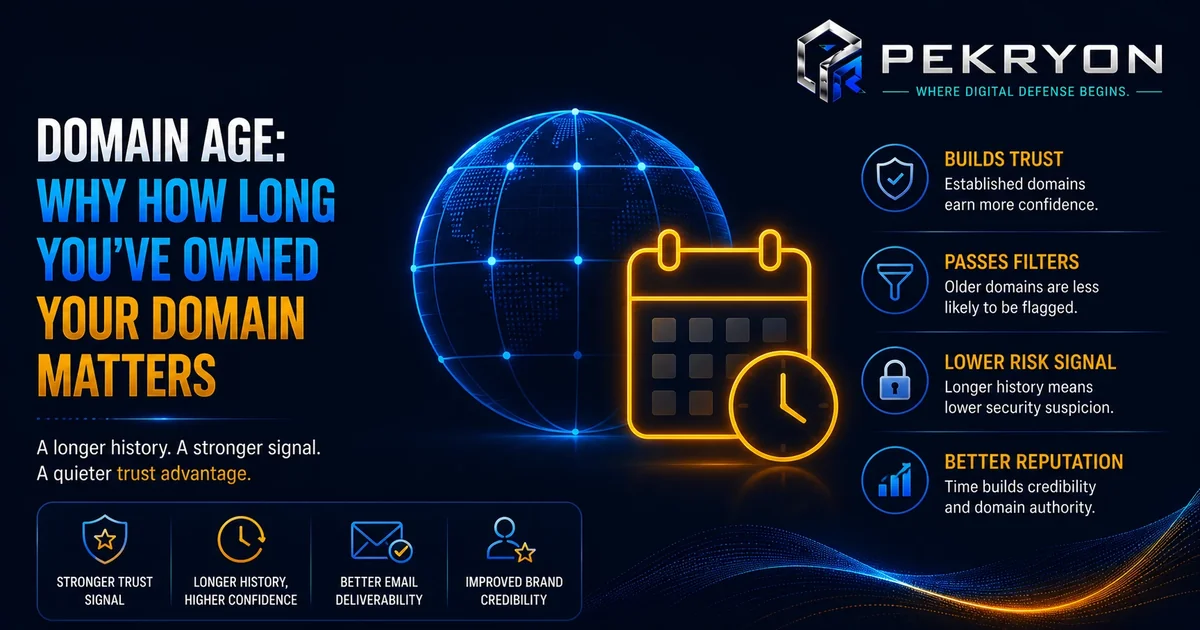
Security tools, browsers, and even trained human instinct treat domain age as one signal of trustworthiness. A domain that's been active for several years, with a consistent history, generally feels more established than one that appeared last week.
Think of it like judging how long a shop has been open in your neighborhood. A shop that's been running for ten years has built a track record. A shop that opened yesterday hasn't had the chance to prove anything yet — good or bad.
Why should you care?
If you're browsing online, knowing about domain age can help you pause before trusting a very new website with sensitive information, like your payment details or login credentials. If you own a website, understanding this concept helps you know why some security tools might treat a newly launched site with more caution at first, even if nothing is wrong with it.
Where do you see it in daily life?
- Security warnings that specifically mention "this domain was recently registered"
- Spam filters treating emails from very new domains a bit more cautiously
- A gut feeling of caution when a website looks brand-new and unfamiliar
- Fraud prevention tools flagging newly registered domains attempting large transactions
How does it work?
Scammers and phishing campaigns often need a fresh domain because their previous ones get blocked or blacklisted quickly once discovered. Because of this pattern, a large share of newly registered domains are involved in scams, spam, or phishing within days or weeks of registration.
Security systems notice this trend across millions of domains and use "how recently was this registered" as one input when calculating an overall risk score. A domain registered yesterday naturally starts with a slightly higher caution flag than one that's been steadily operating for five years — simply because there's less history to judge it by.
Common examples
- A phishing page mimicking a bank's login screen, often registered just days before the campaign starts
- A long-running small business website, registered years ago, with a steady history of normal use
- A newly launched genuine startup, registered only a few weeks ago, that hasn't built up history yet
- A domain that changed ownership recently — its original registration date may be old, but its current use and reputation may have changed
Benefits
Domain age is a genuinely useful early-warning signal. It helps security tools react faster to brand-new phishing campaigns, often before other reputation data (like blacklists) has caught up. It also gives everyday users one more clue to pause and think before trusting an unfamiliar site with sensitive details.
Risks or limitations
Here's the important nuance: domain age alone should never be the only reason to trust or distrust a website.
A well-known exception worth remembering: genuine new businesses, products, and campaigns register brand-new domains every single day, and the overwhelming majority of them are completely legitimate. A new domain age is a reason for a little extra caution and a closer look — not proof of anything wrong. Similarly, an old domain isn't automatically safe forever; if it changes ownership, it can be repurposed for something harmful while still showing an old registration date.
So the honest picture looks like this:
| Situation | What domain age tells you |
|---|---|
| Very new domain, unfamiliar brand | Worth a closer look at other signals before trusting it fully |
| Very new domain, known legitimate launch (e.g., a company you already trust announcing a new site) | Age matters less here — the source and context matter more |
| Old domain, consistent use over years | Generally a positive trust signal |
| Old domain, but recently changed ownership or purpose | Age alone can be misleading — check other current signals too |
Common mistakes beginners make
- Assuming every new website is a scam
- Assuming every old website is automatically safe, without checking anything else
- Not realizing a domain's age doesn't update if it changes hands — the registration date can stay old even if the site's purpose has changed
- Ignoring domain age completely, even when other warning signs are also present
Tips or best practices
- Treat a very new domain as a signal to check other details more carefully, like contact information, secure connection, and how the site was shared with you
- Don't assume an old domain is automatically trustworthy forever — check for other current red flags too
- If you're launching a new legitimate website, be aware that some visitors and security tools may treat it with mild extra caution at first, and that's normal
- Use domain age as one clue among several, not a single deciding factor
If you're ever curious about your own website's domain history and how it factors into its overall reputation, the scanner at pekryon.com can help you check this as part of a wider website report.